5.烯烃制备醇
从烯烃制备醇,也是一个常用的方法,最简单的为烯烃强酸水解,但此方法常常对于复杂的底物是无法应用的;目前一般是通过硼氢化反应得到相应的醇。烯烃羟卤反应可以得到邻卤代醇;烯烃双羟基化可以得到邻二羟基化合物;烯烃羟胺化反应可以邻氨基醇;g-或d-羟基烯烃通过Kennedy氧化环合反应得到相应的2-羟甲基呋喃和吡喃;通过Baylis-Hillman反应可得到a-羟基的不饱和酯或腈等。

5.1 硼氢化反应
Alcohols could be obtained mostly by the reduction of the corresponding carboxylic acids, esters, ketones (including CBS asymmetrical reduction) and aldehydes, or by the hydrolysis of halides. Also there is another method by which the desired alcohols also could be obtained, e.g., hydroboration and oxidation of thecorrespondingalkenes. This classic reaction is often carried out in research labs and it is relatively easy in terms of its operation.
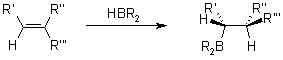
Thesyn-addition of hydroboranes to alkenes occurs with predictable selectivity, wherein the boron adds preferentially to theleast hinderedcarbon. This selectivity is enhanced if sterically demanding boranes are used.More specifically, the boron atom usually adds to theterminalcarbon if a terminal alkene is used as the substrate.
The product boranes may also be used as starting materials for other reactions, such asSuzuki Couplings.

Coupling the hydroboration with a subsequent oxidation of the new-formed borane yieldsanti-Markovnikovalcohols. The hydroboration/oxidation sequence constitutes a powerful method for the regio- and stereoselective synthesis of alcohols.
5.1.1 Mechanism
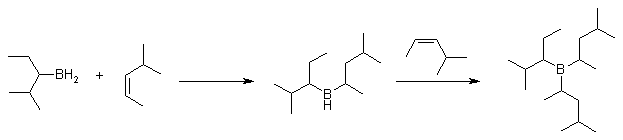
The selectivity of the first addition of borane can be relatively low:


The subsequent additions are more selective as the steric bulk increases, andanti-Markovnikov selectivity predominates in the end:
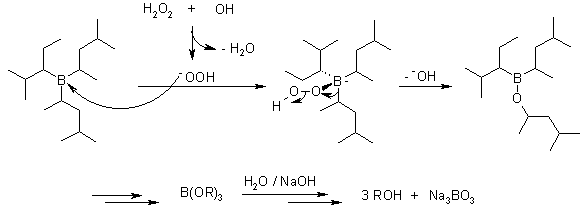
Oxidation withhydrogen peroxide leads to alcohols:
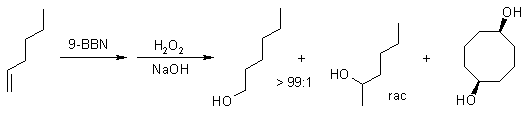
Sterically demanding boranes offer enhanced selectivity. One example of a sterically demanding borane (9-BBN) is generated by the double addition of borane to 1,5-cyclooctadiene:

9-Borabicyclo[3.3.1]nonane

The reactivity and selectivity of the borane reagent may be modified through the use of borane-Lewis base complexes.
5.1.2 Experimental Procedure
A specific example of hydroboration modified by use of borane-Lewis base complexes is demonstrated asbelow.

Reference:J. V. B. Kanth, H. C. Brown,J. Org. Chem, 2001 ,66, 5359-5365.
5.1.3 Procedure:
Hydroboration of Representative Olefins Using Dioxane - BH 2 Cl. Hydroboration of representative olefins, suchas 1-octene, 1-decene,styrene, R-methylstyrene, 2-methyl-1-pentene,cis-4-methyl-2-pentene, 2-methyl-2-butene,â-pinene,cyclohexene, R-pinene, 3-carene, 1-phenyl-2-methyl-1-propene,2,3-dimethyl-2-butene, and1,2-dimethylcyclopentene, withdioxane-BH2Cl was carried out in dioxane and dichloromethanesolvents. The procedure followed for all the olefins
in both the solvents are same. The procedure followed for1-decene in dichloromethane is representative.
An oven-dried 50 mL round-bottom flask provided with aseptum inlet and stirring bar was cooled to 0 °C undernitrogen. The flask was charged with dioxane-BH2Cl indichloromethane (8.7 mL, 5 mmol).To this was added 1-decene(1.4 g, 10 mmol). The final solution is 0.5 M in BH2Cl and 1.0
M in 1-decene.Monitor of the reaction by 11B NMRshowed the completion of the reaction after 15 min.The reaction mixture was treated with slow addition ofwater followed by the addition of sodium hydroxide (7.0 mL,
3 M, 21 mmol).Methanol (3.0 mL) was added followed by theslow addition of hydrogen peroxide (6 mmol), and the contentswere further stirred at room temperature (3 h) and 40 °C (1h) to ensure complete oxidation.The organic compound wasextracted into diethyl ether.Drying and evaporation of thesolvent provided essentially pure 1-decanol in 98% (by GC)isolated 1.48 g, 95% yield.
An efficient way to access of aromatic ketones is the Friedel-Crafts acylation reaction, which has been known for decades and proved to be practical in small and large scale reactions.Although numerous methods to achieve Friedel-Craftsacylation are known, newer methods continue to attractattention for their experimental simplicity and effectiveness.
5.2 烯烃双羟基化制备邻二羟基化合物
在不同的条件下,烯烃双羟基化可以得到顺式和反式邻二羟基化合物。顺式双羟基化常用试剂为高锰酸钾,四氧化锇及碘-湿乙酸银。反式羟基化最常用的方法是过氧酸法,另外,Provost反应也常用。
5.2.1顺式羟基化
在烯烃全羟基化中用高锰酸钾氧化烯烃是应用较广泛的方法。在此氧化反应中,仔细到控制反应条件是非常重要的,否则常发生进一步氧化反应。常规的反应条件是:用水或含水有机溶剂(丙酮、乙醇或叔丁醇)做溶剂,加计算量低浓度(1%~3%)的高锰酸钾,在碱性条件下(12以上),低温反应。在这样的条件下,常可以得到满意的结果。由于不饱和酸在碱性溶液中溶解,所以本法对不饱和酸的全羟基化最为合适,收率也高,如油酸的全羟基化的收率达80%。
其反应机理如下:


对于不溶于水的烯烃,用高锰酸钾做氧化剂时,加入相转移催化剂是有效的。如顺式环辛烯的全羟基化,在相转移催化剂的存在下,收率为50%,而没有相转移催化剂时,收率仅为7%。

四氧化锇作氧化剂进行烯烃的全羟基化是一种较好的顺式羟基化的方法,收率教高。反应历程与高锰酸钾类似,形成环状的锇酸酯。由于锇酸酯不稳定,常加入叔胺(如吡啶)组成配合物,以稳定锇酸酯,加速反应。由于四氧化锇价贵且有毒,实验中常用催化量的四氧化锇和其他的氧化剂,如与氯酸盐、碘酸盐、过氧化氢等共用。
碘与湿羧酸银为氧化剂,由碘与2 mol醋酸银或苯甲酸银所组成的试剂,称为Prevost’s试剂,该试剂可以氧化烯键成1,2-二醇,当有水存在时(Woodward Reaction)得到顺式1,2-二醇的单酯,进而得到顺式加成的1,2-二醇;在无水条件下(Prevost Reaction),则得到反式的1,2-二醇
5.2.2顺式羟基化举例

A mixture of 2-[4-(benzyloxycarbonyl)piperazin-1-yl]-4-[trans-(2-buten-1-yl)oxy]quinazoline (1.30 g), a solution of osmium tetroxide in t-butanol (osmium tetroxide 106 mg/t-butanol 8.36 g) (312 mg) and 4-methylmorpholine N-oxide (382 mg) acetone is distilled off from the reaction mixture under reduced pressure, and the resultant product is diluted with ethyl acetate, and the mixture is washed with 10percent aqueous sodium sulfite solution and water. in water (2 ml)--acetone (15 ml) is stirred at room temperature for 14 hours.. The ethyl acetate solution is dried over anhydrous magnesium sulfate and evaporated to dryness under reduced pressure, and the residue is purified by medium pressure liquid column chromatography (eluent, chloroform:methanol=100:1, v/v) to give 2-[4-(benzyloxycarbonyl)piperazin-1-yl]-4-[(2RS,3RS)-(2,3-dihydroxybutan-1-yl)oxy]quinazoline (1.02 g) as foam. NMR (300 MHz, CDCl3--D2O, dppm): 1.32 (3H, d, J=6 Hz), 3.60 (4H, m), 3.8-4.0 (6H, m), 4.54 (1H, dd, J=6, 11.5 Hz), 4.63 (1H, dd, J=4, 11.5 Hz), 5.17 (2H, s), 7.16 (1H, ddd, J=1, 7, 8 Hz), 7.3-7.4 (5H, m), 7.51 (1H, dt, J=1, 8.5 Hz), 7.62 (1H, ddd, J=1.5, 7, 8.5 Hz), 7.89 (1H, dd, J=1.5, 8 Hz).
5.2.3反式羟基化
烯键的反式羟基化最重要的方法是过氧化物氧化法,另外Prevost反应也常用。
过氧化物氧化烯键可生成环氧化合物,也可以生成1,2-二醇,这主要取决于反应条件。首先过氧化物与烯键反应生成环氧化合物,当反应中存在一些可使环开裂的条件,则环即被开裂成反式1,2-二醇。双氧水、过氧甲酸和过氧乙酸最为常用。其反应机理如下:

反应分两步进行,先是过氧酸氧化烯键成环氧化合物,分离后加酸,酸从烯键平面的另一侧进攻,再水解形成反式1,2-二醇。
5.2.4反式羟基化示例

The full amount of oleic acid (250g, 0.94 mole of unsaturation), formic acid (43.2g, 0.94 mole) and sulphuric acid (0.5g, 0.2percent) were added to a reactor, followed by 15percent of total amount of the required hydrogen peroxide (11g, 1.08 moles). This mixture of reactants was homogenize by stirring. As the stirring was carried out, an increase in temperature was observed, where the temperature of the mixture has risen from 25.deg.C to 60.deg.C. When the temperature started to decrease (55.deg.C), the remaining amount of hydrogen peroxide (62.6g), (total 1.08 moles) was then-added drop-wise with continuous stirring. The temperature of the reaction was maintained between 80-90.deg.C, by applying heat if necessary. The reaction was allowed to take place for 5 hours and the OOC is analyzed until it is less than 0.05; The reaction product from example 1 was poured into a separatory funnel and allowed to settle. The bottom spent acid layer was removed and the top upper organic layer was washed with chilled (5.deg.C to 10.deg.C) water until the pH of washing water and product were in the range of 2.5 to 3.0. The washed crude DHSA was dried under vacuum at 0.1 bar and at temperature 70.deg.C. Product was obtained in74 - 79 %yield.
🔙返回上一页🔙